


Subscribe to our blog for all the latest news, updates, and events from MMA and our partners
Subscribe
Like the economy itself, the insurance market is cyclical and swings like a pendulum, fluctuating between highs and lows. In the insurance industry, a hard market is the upswing in a market cycle, when premiums increase and capacity for most or certain types of insurance decreases. Varying factors for each industry can contribute to its sector’s hard market, and currently, several factors are influencing transportation's hard market. Understanding these can help motor carriers proactively work with their insurance agents to navigate market conditions and the impact on business operations and finances.
Underlying conditions:
In the 1990s, personal injury suits began to increase both in prevalence and monetary value. These set the stage for large legal settlements and verdicts, also known as “nuclear verdicts,” in the transportation industry.
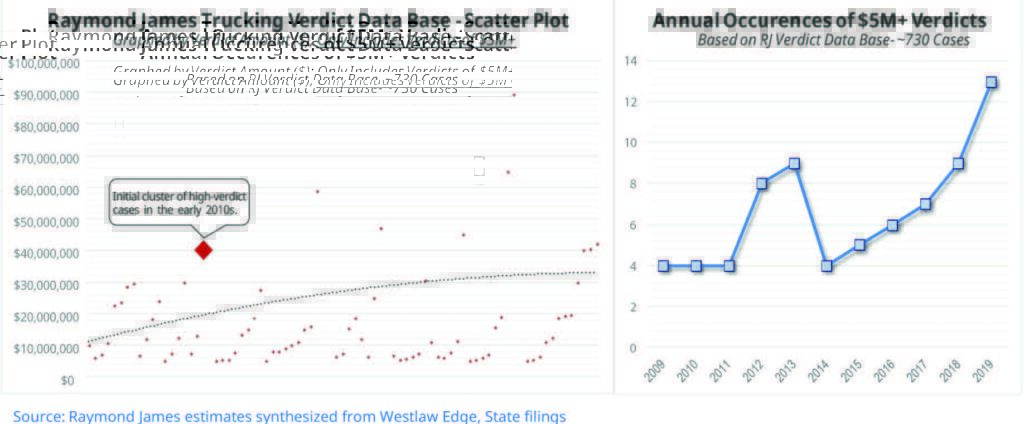
The American Transportation Research Institute reports that the average size of verdicts in the industry from 2010 to 2018 increased from $2.3M to $22.3M — an increase of 967%. When children were involved in a crash, verdict sizes increased more than 1,600%, regardless of fault.
According to ATRI, the largest verdict to date occurred in 2016 from a crash in Alabama involving a truck driver for a Georgia scrap metal company. After falling asleep at the wheel, the truck driver crossed the centerline causing a crash that killed five individuals. Some aspects of the case were settled out of court, but the deaths of a grandmother and two grandchildren were settled in court. The driver, and by extension, the motor carrier was found liable and ordered to pay $280 million.
The rise in large verdicts and settlements has substantially impacted motor carrier operations, causing some to file bankruptcy and others to be forced out of business through untenably high insurance premiums.
ATRI attributes the proliferation of large verdicts and settlements to a number of factors including social inflation (an anti-corporate sentiment
and poor image of the industry), juror desensitization to large dollar amounts, advances in auto safety technologies that save more lives but potentially result in more severe injuries and higher medical costs, and “the dirty five” of truck driver/owner negligence.
The driver shortage as a result of an aging workforce, low training school enrollment and the 21-year-old commercial driver’s license requirement contribute to the hard market as well. One of the most significant considerations for underwriting motor carrier insurance is the driver.
The driver shortage makes it more challenging for motor carriers to hire well qualified drivers, which can translate into more crashes and claims resulting in higher insurance premiums.
This problem will likely not be solved soon. Before the corona-virus pandemic, the American Trucking Associations reported a shortage of 60,000 drivers, and since the pandemic, fewer drivers have entered training school. To help solve the problem and encourage young people to consider a career in transportation and logistics, some motor carriers are getting involved with their local communities to promote the industry and training programs.
Underlying conditions:
Insurance providers/underwriters operate on narrow margins. Effectively managing their underwriting portfolio, the customers they choose to cover, is necessary for them to be competitive and sustainable. In a hard market when profit margins are especially tight and the risks increasingly difficult to manage, they try to improve profitability by re-evaluating industry risks and individual customer risks, raising premiums and lowering limits. They may also restrict coverage through exclusions, non-renewing customers or leaving the industry sector altogether.
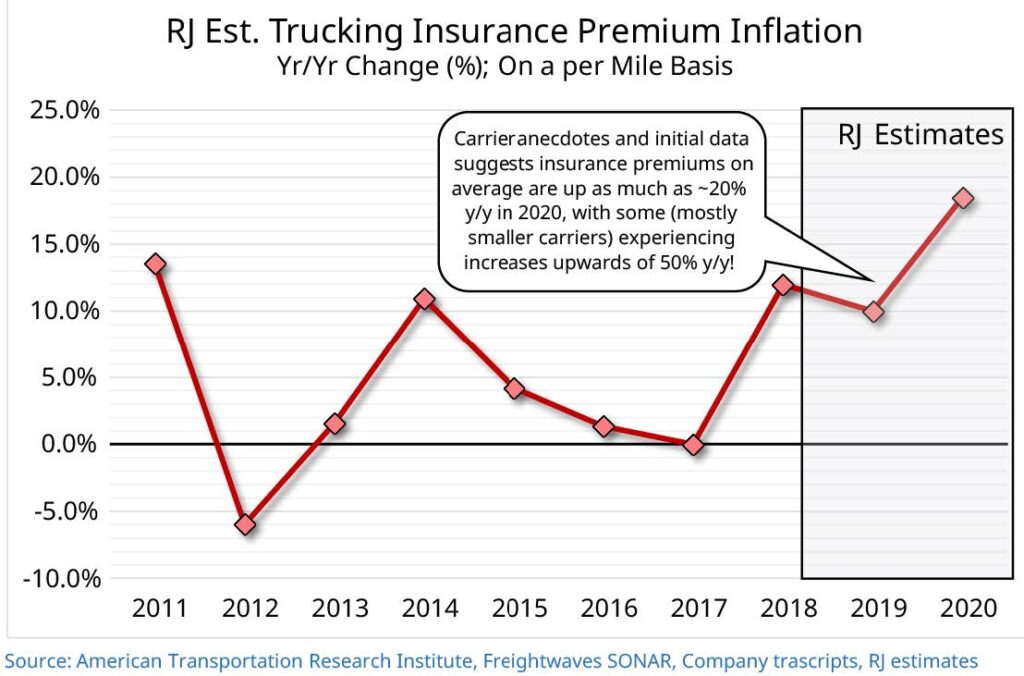
Squeezed by the increase of large verdicts/settlements, margins for insurance providers in the transportation industry have decreased substantially, and they have responded by being more selective in who they insure or by exiting the sector. This environment has resulted in skyrocketing insurance premiums for motor carriers.
This year, most motor carriers can expect a 15–20% premium increase on primary layers if they do not have a recent claim. For motor carriers with recent claims, premiums may increase 30% or more. With excess and umbrella programs, renewals in some cases are up as high as 200%.
“Whether you have a small or large fleet, we want to empower our motor carriers to have an impact on their insurance spend by proactively addressing risk. We suggest starting both short-term and 3-5 -year planning to manage the immediate and long-term impact on finances and operations. Building a risk management strategy within the operations plan is key to lowering premiums and lowering overall risk.”
— Colt Palmer, Marsh McLennan Agency commercial broker specializing in the transportation industry
Palmer recommends motor carriers reach out to their insurance agent eight months out from renewal and multiple times as the date gets closer. Starting early and working with a broker who specializes in the industry and advocates for customers when buying coverage (and during a potential claim) can help motor carriers get the best available pricing. An early start also gives motor carriers time to work with the brokerage’s risk management department to help implement safety protocols and risk prevention strategies, in addition to planning for the likelihood of higher premiums and the financial Carrier Safety.
Managing risk is the No. 1 strategy motor carriers can implement to achieve the lowest percentage of premium increases and reduce the risk
of crashes/claims.
Building an effective risk prevention strategy includes these steps:
Investing in safety technology is one of the most effective risk management strategies. According to the Truck Safety Coalition in a 2017 report, trucks equipped with collision avoidance technology (automatic emergency brakes, lane departure warnings and electronic stability control) decreased drivers’ rear-end collisions by 71%, unsafe following distances by 63%, and improper lane changes by 46%.Preliminary data reported for 2018 and 2019 by the Federal Motor Carrier Safety Administration also suggests that the rising adaptation of “prevention tech” is lowering injury and fatal crashes involving
large trucks.
Telematics systems are also improving safety outcomes. In addition to helping increase fleet efficiency and productivity, managers can use drivers’ safety data to identify drivers who need additional coaching, improving the safety of the entire fleet.
The substantial cost of new technology upgrades and new trucks already equipped is obviously a major consideration for motor carriers. One of the most effective tools in “evidence tech” and the least expensive is dash cam installation.
“Dash cams are the first technology we recommend motor carriers adapt who may be on a particularly tight budget,” said Palmer. “Base models can be purchased affordably for a couple hundred dollars, and the video evidence they provide can be invaluable to show who was at fault in a crash.”
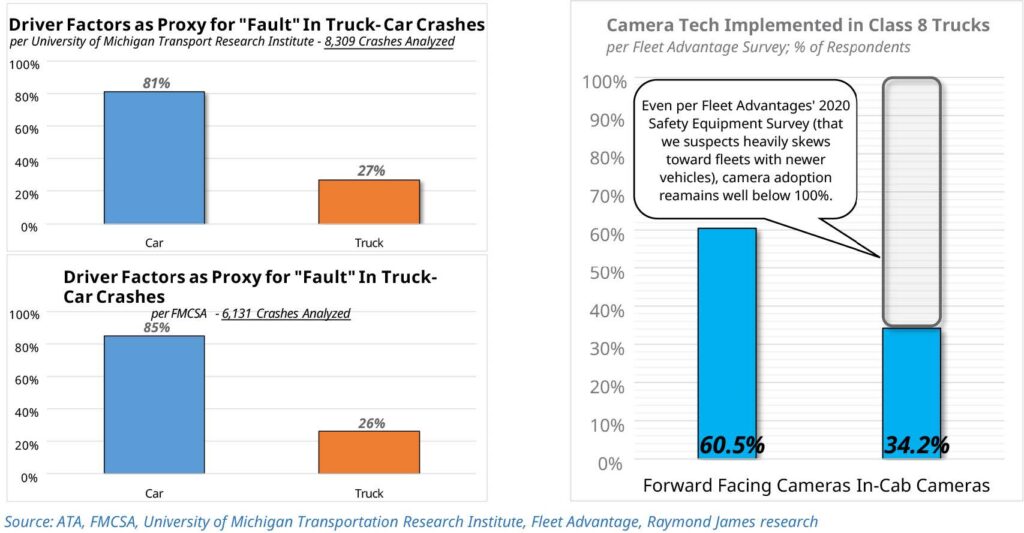
According to the American Trucking Association and FMCSA, passenger vehicle drivers are at fault in 80 – 85% of truck-car crashes. But without any evidence, fleets have no way to exonerate their drivers when they are not at fault. Dash cam footage can change that. Video footage recorded by a dash cam is almost always admissible in court, and fleets can use the footage to exonerate innocent drivers and save the company from massive potential liabilities.
“In today’s environment, fleets need to prove safety. If a claim arises, they need to be armed with proof. Every training document needs to be completed and signed. Every verbal communication to drivers about the lanes they are traveling needs to be recorded or documented,” Palmer added. “It’s work, but it can save fleets millions of dollars.”
Motor carriers that have impeccable safety records may consider
self-insuring their business with other like-minded companies. This kind of insurance is called “captive insurance.” The captive insurance company is wholly owned and controlled by its insured businesses, with the purpose to insure the risks of its owners and achieve risk financing objectives. While the insured business owners put their own capital at risk by investing in the captive, they can benefit from underwriting profits. An insurance broker specializing in the industry can advise if captive insurance is an option worth considering.
Contact an agent today to discuss how we can help you.
Subscribe to our blog for all the latest news, updates, and events from MMA and our partners
Subscribe
Copyright © 2026 Marsh & McLennan Agency LLC., All Rights Reserved.